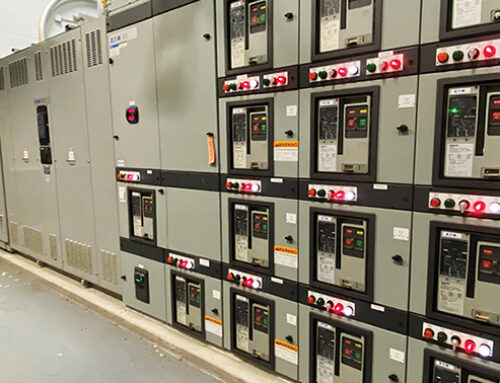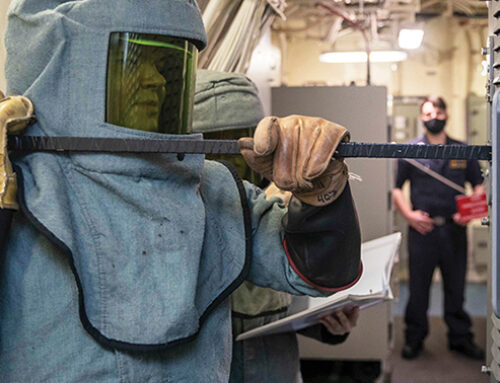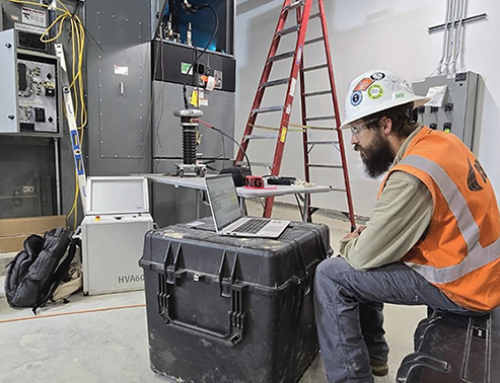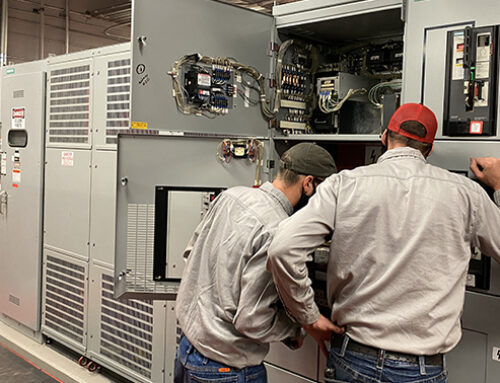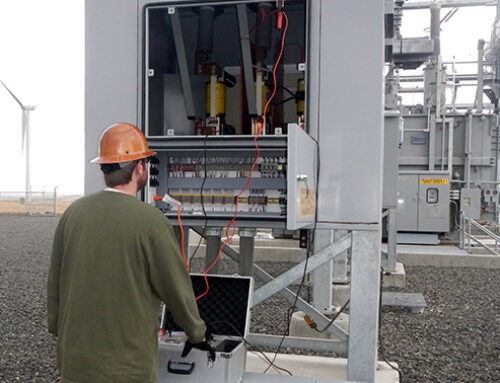
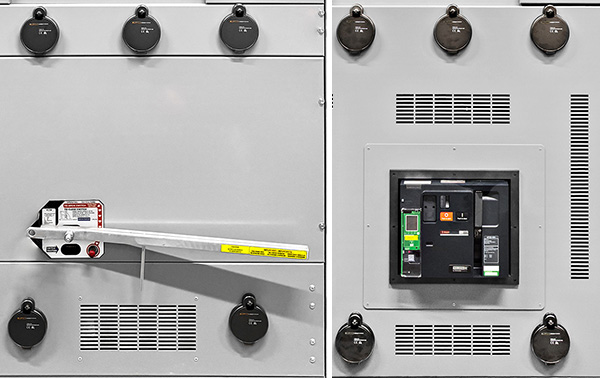
If your facility still relies on bolted pressure switches and aging circuit breakers from the 1970s and ’80s, you’re not alone. These mechanical workhorses were the backbone of 480-V distribution systems for decades, and many are still operating today. The question isn’t whether they’ve served you well, however — it’s whether continuing to depend on them puts your operations at unnecessary risk.
In a recent article in NETA World, Group CBS experts Matthew Wallace and David Muir trace the evolution from mechanical bolted pressure switches to modern microprocessor-based circuit breakers. The historical progression is fascinating, but there is an underlying urgent message: Postponing modernization too long has consequences.
The hidden costs of “If it ain’t broke”
Bolted pressure switches were ingenious solutions for their time. These entirely mechanical devices sense overcurrent through the magnetic fields it creates. But decades of operation have exposed fundamental limitations that weren’t apparent when these systems were new.
Mechanical components wear. Contact surfaces degrade. Calibration drifts. The very design that made these switches reliable in 1975 has made them a liability in 2025. Aging equipment is increasingly susceptible to nuisance trips, calibration drift, and mechanical failures, all issues that translate directly into unplanned downtime and potential safety hazards. More critically, these legacy systems offer no visibility into their own condition.
What modern protection delivers
The gap between legacy mechanical switches and contemporary microprocessor-based protection isn’t incremental — it’s transformational. Modern systems don’t just detect faults more accurately; they provide continuous monitoring, diagnostics, event recording, and communication capabilities that fundamentally change how facilities manage electrical infrastructure.
Where mechanical switches offer fixed trip curves and manual adjustments, microprocessor relays provide programmable protection schemes that can be optimized for specific applications and adjusted without physical modifications. They log disturbances, track trends, and often identify developing problems before they cause failures.
This isn’t about chasing the latest technology for its own sake. It’s about matching protection capabilities to the operational and safety expectations of modern facilities. Equipment that was state of the art in 1980 simply wasn’t designed for the reliability, visibility, and safety standards that facilities require today.
Group CBS companies such as Advanced Electrical & Motor Controls (AEAMC) offer life extension services to retrofit new current-series circuit breakers and replace existing bolted pressure switches with minimal modifications. CBS service shops partner with CBS Field Services to manage all facets of the outage and the retrofit process.
Three paths forward
When facilities decide to modernize, they have three primary options on how to proceed.
- Replace with modern equivalent circuit breakers
Install contemporary circuit breakers with ratings similar to those of existing equipment. This approach offers the most straightforward path, maintaining familiar form factors while providing modern protection capabilities. It’s typically the most cost-effective option for direct equipment replacement. - Upgrade to modern microprocessor-based protection
Retrofit existing breakers with modern electronic trip units or protective relays. This strategy preserves mechanical interrupting equipment while adding sophisticated monitoring and control capabilities. It can extend the useful life of serviceable breakers while delivering most of the benefits of modern protection. - Full system modernization
Replace entire switchgear lineups with contemporary equipment. While requiring the highest initial investment, this approach eliminates accumulated maintenance burdens, standardizes protection across a facility, and positions the electrical system for decades of reliable service.
Each path involves different considerations around budget, downtime, and long-term operational goals. The right choice depends on equipment condition, facility requirements, and business priorities — factors that require careful assessment rather than one-size-fits-all recommendations.
Moving beyond “good enough”
The evolution from bolted pressure switches to modern protection systems reflects a fundamental shift in what we expect from electrical infrastructure. The question facing facility managers isn’t whether their old equipment has failed; it’s whether continuing to operate with 1970s technology makes sense when superior alternatives exist.
For the complete technical discussion, including the historical evolution of circuit protection technology and a detailed examination of modernization considerations, read the full article in NETA World by clicking here.
CBS Field Services’ NETA-certified technicians can assess your existing protection systems and develop a modernization strategy aligned with your facility’s operational needs and budget constraints. We’ll partner with our colleagues at Circuit Breaker Sales to replace or extend the life of your aging equipment.
For more information about our services or to discuss your specific requirements, contact us.
Learn more:
-
- Maximizing Your Solar Investment: Why Photovoltaic Array Testing Matters
- The Critical Moment When Troubleshooting Becomes Repair
- Emergency Support Team Restores Power to Hospital After Two Electrical Faults
- Be the Electrical Technician That Stands Out Among Others
- How to Properly Test Medium-Voltage Cables